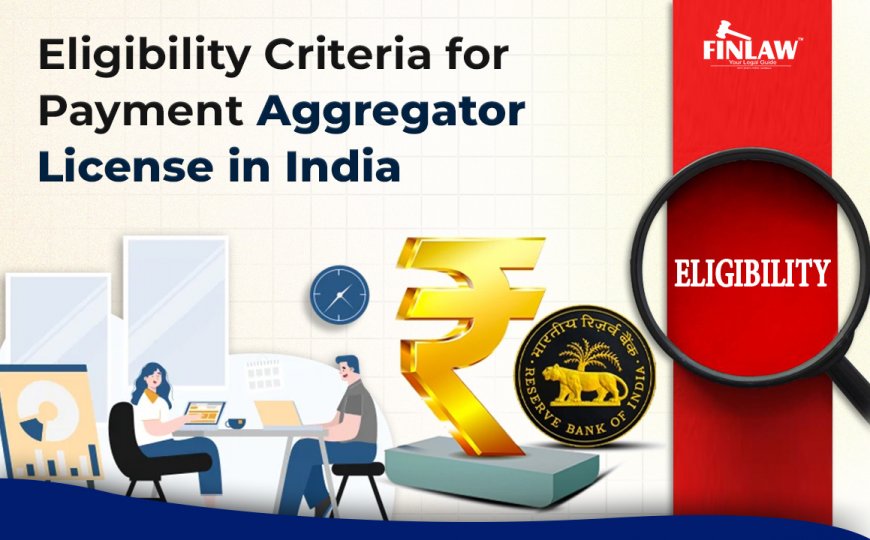
Eligibility Criteria for Payment Aggregator License in India
Understand the eligibility criteria, net worth, and RBI compliance requirements for a Payment Aggregator License in India.

India’s digital payments ecosystem has grown at an extraordinary pace over the past few years. From UPI-led microtransactions to large-scale e-commerce payments, digital payment infrastructure has become central to India’s financial economy. At the heart of this system are Payment Aggregators (PAs) — entities that facilitate online payments for merchants by integrating various payment instruments under one platform.
However, operating as a Payment Aggregator in India is not as simple as launching a tech platform. It requires prior authorization from the Reserve Bank of India (RBI) under the regulatory framework issued in March 2020 and subsequent updates.
In this detailed guide, we explain the eligibility criteria for Payment Aggregator License in India, regulatory requirements, capital norms, governance expectations, and compliance conditions you must meet before applying.
If you are exploring the complete licensing framework, you may also refer to our service page, Payment Aggregator license India.
What is a Payment Aggregator?
A Payment Aggregator (PA) is a non-bank entity that enables merchants to accept various payment instruments such as:
-
Debit cards
-
Credit cards
-
UPI
-
Net banking
-
Wallets
-
Prepaid instruments
The aggregator collects funds from customers and settles them with merchants after deducting applicable fees.
Unlike Payment Gateways (which provide only technological infrastructure), Payment Aggregators handle actual fund flows. Therefore, they are regulated entities and require RBI authorization under the Payment and Settlement Systems Act, 2007.
Why RBI Regulation is Necessary
The RBI regulates Payment Aggregators to:
-
Protect consumer funds
-
Ensure proper KYC and AML compliance
-
Prevent misuse of escrow accounts
-
Strengthen cyber security standards
-
Maintain transparency in merchant onboarding
Without RBI approval, no non-bank entity can legally operate as a Payment Aggregator in India.
Eligibility Criteria for Payment Aggregator License in India
To obtain RBI approval, an applicant must satisfy multiple regulatory, financial, structural, and compliance conditions.
Let’s examine each eligibility requirement in detail.
1. Company Structure Requirement
Only a company incorporated under the Companies Act, 2013 (or 1956) is eligible to apply.
Key Structural Conditions:
-
Must be a public limited company or private limited company
-
Partnership firms, LLPs, sole proprietorships are not eligible
-
The main object clause in the Memorandum of Association (MoA) must permit payment aggregation activities
-
Foreign companies must comply with FDI regulations
If the company is newly incorporated, it must structure its constitutional documents carefully before filing the application.
2. Minimum Net Worth Requirement
One of the most critical eligibility criteria is the minimum net worth requirement prescribed by RBI.
Net Worth Norms:
-
₹15 crore at the time of application
-
Must be increased to ₹25 crore within three financial years
-
₹25 crore must be maintained at all times thereafter
Net worth includes:
-
Paid-up equity capital
-
Free reserves
-
Share premium
It excludes:
-
Revaluation reserves
-
Intangible assets
-
Deferred revenue expenditure
The net worth must be certified by a Chartered Accountant.
Failure to maintain the prescribed net worth can result in cancellation of authorization.
3. Fit and Proper Criteria
RBI applies a strict “Fit and Proper” assessment to promoters and directors.
Evaluation Parameters:
-
Financial integrity
-
Track record of business conduct
-
Criminal background verification
-
No history of regulatory violations
-
No wilful default status
The RBI may also evaluate:
-
Group structure
-
Ultimate beneficial ownership
-
Past regulatory actions in India or abroad
Promoters must submit declarations and supporting documents confirming compliance with fit and proper standards.
4. Foreign Direct Investment (FDI) Compliance
If the Payment Aggregator has foreign investment:
-
It must comply with the Consolidated FDI Policy
-
Sectoral caps and approval routes must be adhered to
-
Downstream investment rules apply
-
Beneficial ownership disclosures are mandatory
Certain countries sharing land borders with India require prior government approval for investment.
Non-compliance with FDI regulations can lead to application rejection.
5. Escrow Account Compliance
Payment Aggregators must maintain an escrow account with a scheduled commercial bank.
Key Escrow Requirements:
-
Funds collected from customers must be kept in escrow
-
Settlement timelines must comply with RBI norms
-
No co-mingling of operational funds
-
Clear merchant settlement mechanism
The escrow agreement must be legally structured and compliant with RBI guidelines.
6. Merchant Onboarding Standards
RBI requires strict merchant onboarding and due diligence.
Mandatory KYC Compliance:
-
PAN verification
-
Business registration documents
-
Bank account validation
-
GST verification (if applicable)
-
AML screening
Payment Aggregators must implement risk-based merchant categorization and enhanced due diligence for high-risk businesses.
High-risk sectors (such as gaming, crypto, forex trading, etc.) require special compliance measures.
7. Technology and Cyber Security Framework
Payment Aggregators must have robust IT systems.
Required Controls:
-
PCI-DSS compliance
-
Data localization requirements
-
Encryption standards
-
Fraud monitoring mechanisms
-
Incident response systems
The entity must undergo system audits by CERT-In empaneled auditors.
RBI places strong emphasis on cyber resilience and data protection due to the sensitive nature of payment transactions.
8. Governance and Board Structure
Corporate governance is another important eligibility component.
Governance Expectations:
-
Adequate board oversight
-
Independent directors (where applicable)
-
Audit committee structure
-
IT strategy committee
-
Risk management framework
The board must approve:
-
Information security policy
-
Merchant onboarding policy
-
Grievance redressal mechanism
-
Settlement process
Proper documentation and board resolutions are mandatory.
9. Business Plan and Operational Readiness
RBI requires submission of a detailed business plan including:
-
Target merchant segments
-
Revenue model
-
Risk management strategy
-
Technology architecture
-
Projected financial statements (3–5 years)
Applicants must demonstrate operational readiness rather than a mere conceptual proposal.
10. Grievance Redressal Mechanism
A proper customer grievance redressal system is mandatory.
Required Elements:
-
Nodal officer appointment
-
Escalation matrix
-
Defined response timelines
-
Complaint tracking system
Consumers must have clear channels for dispute resolution.
11. AML & PMLA Compliance
Payment Aggregators are required to comply with:
-
Prevention of Money Laundering Act (PMLA), 2002
-
KYC Master Directions
-
Suspicious Transaction Reporting (STR)
-
Transaction monitoring
An internal compliance officer must be appointed to oversee AML compliance.
12. Reporting and Audit Requirements
Authorized Payment Aggregators must:
-
Submit periodic returns to RBI
-
Conduct statutory audits
-
Perform system audits
-
Maintain transaction-level data
-
Preserve records as per regulatory norms
Continuous regulatory compliance is mandatory post-authorization.
Application Process Overview
The application for a Payment Aggregator license involves:
-
Company incorporation (if not already incorporated)
-
Net worth infusion
-
Preparation of policies and compliance framework
-
Filing application with RBI
-
RBI scrutiny and clarifications
-
In-principle approval
-
Final authorization
The review process can take several months depending on documentation quality and regulatory scrutiny.
Common Reasons for Rejection
Many applications face delays or rejection due to:
-
Inadequate net worth
-
Poorly drafted policies
-
Weak business model
-
Insufficient governance framework
-
Non-compliance with FDI rules
-
Lack of clarity in merchant risk controls
Professional structuring significantly increases approval probability.
Key Compliance Obligations After License
Obtaining the license is only the beginning. Ongoing obligations include:
-
Maintaining minimum net worth
-
Escrow account monitoring
-
Regulatory reporting
-
Merchant risk reviews
-
Data security audits
-
Periodic RBI inspections
Failure to comply may result in penalties or license cancellation.
Who Should Apply for a Payment Aggregator License?
Entities that typically apply include:
-
Fintech startups
-
E-commerce infrastructure providers
-
Digital payment platforms
-
Cross-border payment facilitators
-
Large merchant marketplaces
However, each applicant must assess capital capacity, compliance readiness, and long-term operational commitment.
Strategic Considerations Before Applying
Before initiating the licensing process, consider:
-
Capital lock-in implications
-
Technology infrastructure costs
-
Compliance team setup
-
RBI scrutiny level
-
Timeline expectations
Entering the regulated payments ecosystem requires strong financial backing and regulatory preparedness.
Final Thoughts
The eligibility criteria for a Payment Aggregator License in India are designed to ensure financial stability, technological robustness, and consumer protection. The RBI’s regulatory framework reflects a balance between fostering fintech innovation and safeguarding the financial system.
From minimum net worth requirements to strict governance and cybersecurity controls, every applicant must demonstrate operational maturity and regulatory discipline.
If you are planning to enter India’s regulated payment ecosystem, a structured legal and compliance strategy is essential. For a complete understanding of documentation, process flow, timelines, and advisory support, explore our license services: Payment Aggregator license India.
A well-prepared application not only increases approval chances but also positions your business for long-term regulatory sustainability in India’s rapidly expanding digital payments market.
What's Your Reaction?