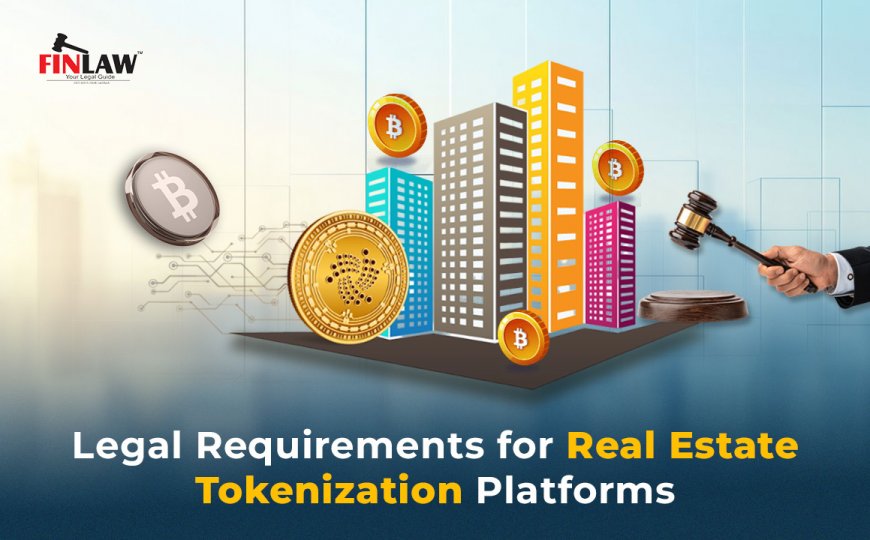
Legal Requirements for Real Estate Tokenization Platforms in India
Learn the legal requirements for Realestate Tokenisation platforms in India, including SEBI, RERA, AML, FEMA compliance, taxation, and regulatory risks.

The concept of Realestate Tokenisation is rapidly transforming the way investors access property markets. By converting ownership of real estate assets into blockchain-based digital tokens, platforms can enable fractional ownership, global investment access, and improved liquidity. However, despite the technological innovation, launching a real estate tokenization platform in India requires careful navigation of multiple laws and regulatory frameworks.
Unlike traditional property transactions, tokenization combines real estate law, securities regulation, fintech compliance, and digital asset rules. Since India does not yet have a dedicated law for tokenized assets, platforms must comply with a combination of existing legislation and regulatory guidelines.
This article explains the legal requirements, regulatory framework, compliance obligations, and risks involved in operating a real estate tokenization platform in India.
What is Real Estate Tokenization?
Real estate tokenization refers to the process of converting ownership or economic rights of a property into digital tokens stored on a blockchain. These tokens represent fractional interests in a real estate asset and can be bought, sold, or traded on digital platforms.
For example:
-
A commercial property worth ₹50 crore can be divided into 50,000 tokens.
-
Each token may represent a small ownership stake or income share.
-
Investors can purchase tokens instead of buying the entire property.
This model allows investors to participate in premium real estate markets with relatively smaller capital.
However, tokenizing property does not automatically grant legal ownership under Indian law, which creates regulatory challenges for platforms offering these services.
Legal Status of Real Estate Tokenization in India
Currently, India does not have a dedicated regulatory framework for Realestate Tokenisation. Instead, tokenization platforms must comply with multiple laws governing:
-
Real estate transactions
-
Securities and investments
-
Digital assets and taxation
-
Anti-money laundering regulations
Regulators such as the Securities and Exchange Board of India (SEBI), Reserve Bank of India (RBI), and Financial Intelligence Unit-India (FIU-IND) may oversee different aspects of the platform depending on how the tokens are structured.
If tokens represent profit-sharing or fractional investment, they may be treated as securities and subject to securities law compliance.
Key Legal Requirements for Real Estate Tokenization Platforms
1. Compliance with Real Estate Laws
Any platform offering tokenized property investments must comply with India’s core real estate laws.
Real Estate (Regulation and Development) Act, 2016 (RERA)
RERA is the primary regulatory framework governing real estate projects in India. Developers must register projects with the relevant state authority before marketing or selling units.
For tokenization platforms, this means:
-
The underlying property must be RERA compliant
-
Project details must be publicly disclosed
-
Funds must follow escrow and project usage rules
Even if the investment is tokenized, the physical property remains subject to RERA obligations.
Transfer of Property Act, 1882
The transfer of ownership of immovable property in India requires a legally executed sale deed. Blockchain records alone do not replace this requirement.
Therefore:
-
Token transfers do not legally transfer property ownership.
-
The legal ownership must still be recorded through traditional property documentation.
Registration Act, 1908
Property transfers must be registered with government land registries.
This means:
-
Tokenized transactions cannot replace registered deeds.
-
Ownership must be linked to the registered property owner.
2. Securities Law Compliance
Most tokenized real estate offerings involve fractional ownership and profit sharing, which may classify tokens as securities under the Securities Contracts (Regulation) Act, 1956.
If tokens are classified as securities, the platform may need to comply with:
-
SEBI disclosure requirements
-
Prospectus and investor protection rules
-
Licensing of intermediaries
-
Restrictions on public investment offerings
Failure to comply can lead to regulatory action and penalties.
3. Structuring Through Special Purpose Vehicles (SPVs)
Due to the legal limitations of tokenized ownership, most platforms structure tokenization through a Special Purpose Vehicle (SPV).
Typical structure:
-
A company or trust (SPV) purchases the property.
-
Investors buy tokens representing shares in the SPV.
-
The SPV distributes rental income or capital gains to token holders.
This approach aligns tokenized investments with existing corporate and securities laws and ensures enforceable ownership rights.
4. Companies Act Compliance
If the tokenized structure uses an SPV or corporate entity, it must comply with the Companies Act, 2013.
Key requirements include:
-
Incorporation of the SPV company
-
Board governance and reporting
-
Shareholder agreements
-
Statutory filings with the Registrar of Companies (ROC)
In many cases, tokens represent shares or units of the SPV, making corporate governance essential.
5. AML and KYC Compliance
Real estate tokenization platforms must follow strict Anti-Money Laundering (AML) and Know Your Customer (KYC) rules.
Under the Prevention of Money Laundering Act (PMLA), platforms must:
-
Verify investor identities
-
Monitor suspicious transactions
-
Maintain records for regulatory review
-
Report suspicious activities to FIU-IND
Compliance typically includes:
-
PAN verification
-
Aadhaar-based eKYC
-
Address verification
-
Enhanced due diligence for high-risk investors
6. FEMA Compliance for Foreign Investors
Real estate tokenization can attract international investors, but foreign participation is regulated under the Foreign Exchange Management Act (FEMA).
Restrictions include:
-
Limits on foreign investment in real estate
-
Rules for capital inflow and repatriation
-
Reporting requirements to the RBI
Allowing foreign investors to purchase tokens representing Indian real estate without proper structuring may violate FEMA regulations.
7. Taxation and Virtual Digital Asset Rules
Taxation of tokenized real estate investments remains complex.
Possible tax implications include:
Capital Gains Tax
Investors may pay capital gains tax when selling tokens representing property interests.
30% Tax on Digital Assets
If tokens are categorized as Virtual Digital Assets (VDAs) under Indian tax law:
-
Gains may be taxed at 30%
-
1% TDS may apply to token transfers
GST
Platforms charging service fees may be liable to pay GST on their services.
Stamp Duty
Stamp duty generally applies to property transfers and may also arise when the underlying asset changes ownership.
8. Benami Transaction Compliance
India strictly prohibits property transactions where ownership is held in one person’s name but paid for by another person.
The Prohibition of Benami Property Transactions Act, 1988 bans such arrangements to prevent tax evasion and illicit wealth concealment.
Tokenization platforms must ensure:
-
Transparent ownership structures
-
Clear legal documentation
-
No hidden or proxy ownership arrangements
9. Technology and Smart Contract Compliance
While blockchain enables automated transactions, platforms must ensure:
-
Smart contract security audits
-
Transparent token issuance mechanisms
-
Secure custody of investor funds
-
Robust cybersecurity infrastructure
Regulators increasingly expect fintech platforms to maintain strong technical and compliance controls.
Key Regulatory Authorities Involved
Operating a Realestate Tokenisation platform in India may involve oversight from multiple regulators:
|
Regulator |
Role |
|
SEBI |
Securities and investment regulations |
|
RBI |
Payment systems and foreign exchange rules |
|
FIU-IND |
AML reporting and compliance |
|
State RERA Authorities |
Real estate project regulation |
|
Ministry of Corporate Affairs |
Company and SPV compliance |
This multi-regulator environment makes legal structuring crucial for platform operators.
Major Legal Challenges in Real Estate Tokenization
Despite growing interest in tokenized property investments, several challenges remain.
Lack of Dedicated Regulation
India does not yet have a specific law governing tokenized real estate.
Ownership Enforceability
Blockchain records cannot replace government land registries.
Secondary Market Restrictions
Trading tokens on unregulated exchanges may violate securities laws.
Investor Protection Concerns
Regulators remain cautious due to risks of fraud and unregistered investments.
Because of these challenges, tokenization platforms must prioritize compliance-first business models.
Future of Real Estate Tokenization in India
Although regulations are still evolving, the future of Realestate Tokenisation in India looks promising.
Potential developments include:
-
Dedicated regulatory frameworks for tokenized assets
-
Integration with regulated investment vehicles like REITs
-
Regulatory sandbox experimentation
-
Improved blockchain adoption in land registries
Financial innovation hubs such as GIFT City may also play a key role in shaping the regulatory landscape for tokenized assets.
Conclusion
Real estate tokenization has the potential to revolutionize property investment by making real estate more accessible, liquid, and transparent. However, launching a tokenization platform in India requires navigating a complex web of laws covering real estate, securities, taxation, AML compliance, and foreign investment.
For platforms planning to enter this space, compliance is not optional—it is the foundation of a legally sustainable business model. Structuring tokenized investments through SPVs, regulatory licensing, and strict KYC/AML processes is essential to mitigate legal risks.
As regulatory clarity improves, Realestate Tokenisation could become a major innovation in India’s property and fintech sectors, unlocking new opportunities for investors, developers, and digital asset platforms.
What's Your Reaction?